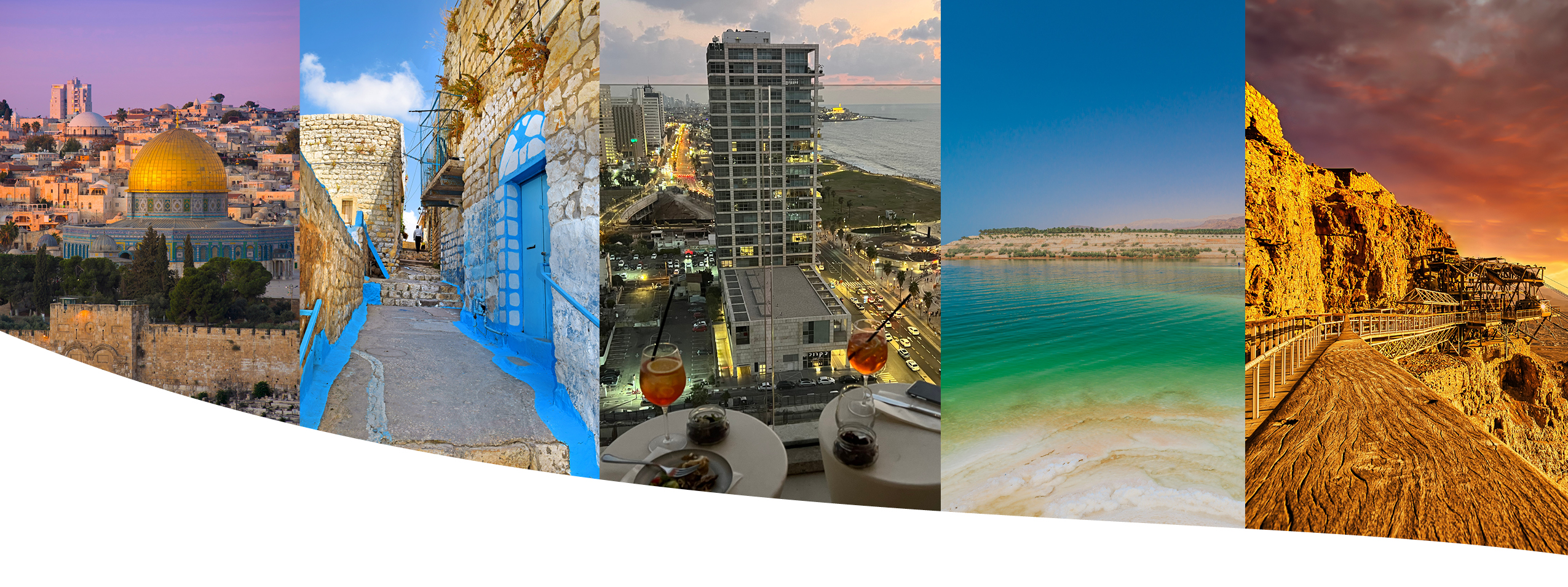
Embark on a once-in-a-lifetime spiritual and cultural journey through the heart of Israel. Walk in the footsteps of prophets and pioneers. Witness resilience, renewal, and faith—ancient and modern.
Highlights Include:
- Walk through Jerusalem’s Old City including the Western Wall Tunnels and the Christian Quarter
- Ascend Masada & float in the Dead Sea, a blend of history and natural wonder
- Journey to northern Israel via private helicopter for an unforgettable day featuring a geopolitical briefing by the IDF, a Druze culinary workshop, and wine tasting in the Golan Heights
- Walk the Via Dolorosa and visit the Church of the Holy Sepulcher, Nazareth & Magdala, key Christian sites throughout Israel
- Explore the Israel-Lebanon border by ATV while gaining insight into regional geopolitics
- Meet October 7th survivors & dine with IDF soldiers currently defending the Jewish state
- Experience the energy of Tel Aviv – Israel’s cultural capital – where cutting-edge art, lively markets, stunning beaches, and rich history come together in one unforgettable city
Optional Petra & Wadi Rum Extension: May 10-11, 2027
Trip Co-Chairs:
Judy Berman & Rob Sarich
Yoram Levy & Cyndy Neighbors
What’s Included
Included in Your Trip
- 11 days touring Israel on a deluxe, air-conditioned coach bus
- English-speaking tour guide throughout the trip
- Full-time security detail
- 5-star accommodations
- 4 nights at the David Citadel (Jerusalem)
- 3 nights at the Kempinski Hotel (Tel Aviv)
- 3 nights at Mitzpe Hayamim (Northern Israel)
- Upgraded room categories may be available at additional cost
- Transfers to and from Ben Gurion Airport for main arrival and departure flights (flight times TBA)
- Porterage at Ben Gurion Airport and at all hotels
- Meals: daily breakfast, 5 lunches, and 7 dinners
- All program activities including touring, entrance fees, and speakers
- Gratuities for Israeli tour guides, drivers, hostess, and security
Not Included
- Roundtrip airfare, departure taxes, and fuel surcharges
- Ground transportation to and from airports within the U.S.
- Border taxes or visa fees
- Meals not listed above
- Personal items
- Travel insurance (strongly recommended)
- Any costs associated with COVID-19 testing or vaccination
Pricing & Payment Schedule
| Payment | Double Occupancy | Single Occupancy | Due By |
|---|---|---|---|
| Non-refundable deposit | $1,000 | $1,000 | December 4, 2026 |
| 80% payment | $9,840* | $12,655* | January 8, 2027 |
| Final payment (100%) | $12,299* | $15,818* | March 12, 2027 |
*All rates displayed are in U.S. Dollars and based on full payment by check or cash. A mandatory 3% fee will be assessed for credit card payments. Double-occupancy rates assume standard room, shared. Confirm your spot with a $1,000 non-refundable deposit at registration.
Cancellation Policy
Given the nature of the situation in Israel and other regional security concerns, the Trip may be canceled at the discretion of the Israeli Tour Provider, Jewish Philanthropies of Southern Arizona, or at the direction of Israeli authorities. If the Trip is canceled due to force majeure, the deposit will be waived and all additional payments refunded.
Cancellation less than 30 days prior to trip start requires payment of 80%. Cancellation less than 2 weeks prior to trip start requires payment in full.
To cancel, please notify Emily Richman in writing at [email protected].

Frequently Asked Questions
What are the trip dates?
The trip runs April 29 – May 9, 2027 (10 nights, 11 days). All participants must arrive in Israel no later than noon on April 29 and leave no earlier than 11:00pm on May 9.
An optional Petra & Wadi Rum, Jordan, extension is available May 10 – 11, 2027. Please reach out to Emily Richman at [email protected] if you are interested in learning more.
Where will we stay?
- Jerusalem (4 nights) – David Citadel Hotel
- Tel Aviv (3 nights) – Kempinski Hotel
- North/Galilee (3 nights) – Mitzpe Hayamim Hotel
Who can participate?
The target demographic for this trip is singles and couples ages 50+, regardless of religion, looking for a high-end, luxury trip to experience the depth and beauty of Israel. During this trip, you will share Jewish experiences (e.g., Shabbat, Havdalah) and experience other religions observed and celebrated in Israel (e.g., visiting the Church of the Holy Sepulcher, visiting a Mosque, etc.).
Participation in this trip is by invitation only.
Who is leading this trip?
Our trip Co-Chairs are Judy Berman & Rob Sarich and Yoram Levy & Cyndy Neighbors.
We will also be accompanied by two JPSA staff members, Hava Leipzig Holzhauer (President/CEO) and Emily Richman (CDO), who will serve as invaluable resources before, during, and after our trip.
What is JPSA’s connection to this trip?
Jewish Philanthropies of Southern Arizona has the partners, relationships, and experience to create a first-class, meaningful trip. JPSA staff are our primary point of contact with the Israeli tour provider including itinerary development, handling all financial aspects of the trip, and trip troubleshooting.
In addition, it is JPSA’s mission to have a thriving Jewish community in Southern Arizona. Trips by cohort like this one deepen local relationships and our connection to Israel and with global Jewry.
Will I be asked for donations on this trip?
There is no minimum financial commitment to JPSA’s Annual Campaign to participate in this trip nor will fundraising take place while in Israel.
Instead, traveling with JPSA staff is a way to connect both with Israel and with Southern Arizona and it is our hope that trip participants will learn (more) about JPSA, meaningfully connect with JPSA staff, and (continue to) be involved in the community – and with Israel – long after you return home.
What are the travel requirements for Israel?
Passport validity: Your passport must be valid for at least six months beyond the end of the trip.
Electronic Travel Authorization (ETA-IL): As of January 1, 2025, U.S. citizens traveling to Israel for tourism must obtain an ETA-IL before departure. The application is online, costs approximately $7, and is valid for two years or until your passport expires, whichever comes first. Apply at least 72 hours before travel at israel-entry.piba.gov.il.
Connecting through other countries? Verify whether that country requires its own electronic travel authorization. Active systems include the UK, Canada, Australia, New Zealand, the EU (ETIAS), Kenya, South Korea, and others.
How do I book my flights?
Each participant is responsible for making their own flight arrangements. We will share suggested group flight information closer to the trip dates.
You are welcome to book the group flight option or arrange your own flights, as long as you arrive at Ben Gurion Airport in time for the group transfer window on April 29, 2027 (TBD) and no later than noon on April 29.
Is this trip right for me if I’ve never been to Israel or if I’m not Jewish?
Absolutely. This trip is designed to give first-time visitors – regardless of religion – a rich introduction to Israel: its people, places, faith traditions, and contemporary story. You will witness the impact of our community on the ground and meet the Israelis whose lives we help shape, creating a lasting relationship with the country from your very first visit.
I’ve been to Israel before – will this trip still feel new?
Yes. Post-October 7, Israel is a country transformed, and this itinerary is built to meet that moment. You’ll visit sites and meet people unique to this chapter in Israel’s history, including October 7 survivors and IDF soldiers currently defending the country. Even for seasoned travelers, there will be new geography, new voices, and new perspectives.
Why travel with a group?
Group travel is the ultimate bonding experience. You will form friendships that last well beyond the trip. Group travel also provides personalized VIP service, group pricing, and access to sites and people that would be difficult to arrange on your own. And it lifts the logistical burden – meals, transportation, portage, and the day-to-day itinerary are all handled for you.
What will security be like? Should I be concerned about safety?
The safety and well-being of participants is the top priority of JPSA as well as of Giant Leaps (our Israeli tour partner). We take every appropriate precaution:
- During trip planning, every route and site is vetted for safety and accessibility.
- The day before the group arrives, the full trip route is re-vetted by security personnel and our on-the-ground staff.
- Each morning, our team consults with Israeli security authorities to confirm the day’s route.
- We remain in constant contact with Israeli security officials and receive ongoing updates about all areas of the country.
- We work exclusively with licensed security companies.
- An armed security guard will accompany the group throughout the entire visit to Israel.
- If routes need to change for safety reasons, we will not hesitate to adjust.
We treat our participants as family, with the same level of care throughout the trip.
Do I need travel and health insurance?
Travel insurance is not included in the trip cost and is strongly recommended. Consider both trip-cancellation coverage and supplemental international health coverage. When reviewing policies, check carefully for war exclusions; some standard policies exclude regional conflict zones.
Companies to consider:
- Redpoint Travel Protection
- Allianz Travel Insurance
- Travelex Insurance
- Arch RoamRight
- Covac Global
- InsureMyTrip (comparison site)
We also strongly encourage you to check international coverage through your current health insurance provider, as participants are responsible for their own medical expenses during the trip.
When will the itinerary be finalized?
A draft itinerary will be shared with registered participants. Itinerary updates continue throughout the week before the trip, and even then, adjustments may occur based on scheduling, unique opportunities, and safety considerations. Flexibility is essential; our goal is to be accurate and well-prepared while staying responsive to conditions on the ground.
Is the trip accessible for mobility issues?
The trip and our transportation are not currently set up for someone traveling full-time in a wheelchair or with significant mobility issues. If you use a wheelchair or scooter full-time, please contact us before booking to discuss options.
Many Israeli sites are accessible but still involve uneven stone walkways or dirt paths. Where possible we’ll minimize walking, and you can always remain near the bus or at a convenient location while the group continues.
If you have any mobility concerns, please discuss them with our team in advance so we can align on expectations.
Can I see family and friends in Israel during the trip?
Yes. If you have family or friends in Israel, you are welcome to arrange visits during free evenings and other times on the itinerary. There may be an opportunity to invite family to join our group during a select meal at an additional expense.
Can I do things on my own during the program?
Our strongest encouragement is to stay with the group throughout the trip as it is the way to get the most out of this unique and special experience. In addition, splitting off mid-program makes logistics difficult for staff and can dilute the group dynamic.
Outside of illness or extraordinary circumstances, we ask all participants to remain with the group during organized programming.
That said, if you choose to break off from the group for any reason (illness or otherwise), please know that you will not be reimbursed for missed activities.
What will the weather be like and what should I pack?
Late April and early May is shoulder season in Israel: warm and mostly dry, with cool evenings. Daytime highs typically run 70 – 80°F (21 – 27°C) across the country; evenings in Jerusalem and the Galilee can drop to the low 50s°F (around 10 – 13°C). Tel Aviv tends to be warmer and more humid than Jerusalem. Pack a light jacket for evenings and a compact rain layer just in case. NOTE: Our coach bus is air-conditioned and heated throughout the trip. Dress throughout Israel is generally casual (much like Tucson). Pack comfortable, easily laundered clothing and layers. Comfortable walking shoes are essential.
For religious sites and Shabbat, men may want slacks and a collared shirt; women may want a skirt or pants covering the knees and a top with sleeves below the elbow. A light shawl or scarf is useful for covering up at holy sites.
Also bring sunglasses, sunscreen, a hat, a reusable water bottle, and a Type H plug adapter (Israel runs on 230V / 50Hz). Keep valuables, your passport, and prescription medications in your carry-on, and use the hotel safe once you arrive.
How much luggage can I bring?
Transatlantic flights generally allow one checked piece of luggage and one carry-on per person. Check your carrier’s specific rules on weight and size.
Security questions about your luggage are routine at Ben Gurion Airport. Do not accept mail, packages, or unknown items from anyone at or near the airport.
What about gratuities?
Gratuities for your Israeli tour guide, bus driver, hostess, and security team are included in your trip cost. You do not need to tip these trip personnel separately, though you are always welcome to offer more if you feel inspired.
Tipping at restaurants on your own time is customary: 15% to 20% is standard. Let your server know before paying by card whether you’d like to add a tip – once the card is charged, gratuity cannot be added afterward. Cash tips in shekels or dollars are always appreciated.
How much spending money will I need?
That depends on your preferences. Meals not included in the program typically run $15 to $50 depending on the restaurant and city. Beyond that, most spending goes toward souvenirs, coffee, and personal items.
Credit cards are widely accepted in Israel, as are ATM cards at Israeli banks (you’ll need a 4-digit PIN). ATMs generally offer the best exchange rate. The local currency is the New Israeli Shekel (NIS). Check with your credit card company about foreign transaction fees before you travel.
Can I use my cell phone in Israel?
Yes, with a few considerations:
- International roaming: Most U.S. carriers offer international plans that include Israel. Check rates before departure; roaming without a plan can be expensive.
- Local SIM or eSIM: For longer stays, an Israeli SIM or eSIM can be cheaper. You’ll need an unlocked phone for a physical SIM.
- Wi-Fi: Widely available at hotels, cafes, and public areas.
- Messaging apps: WhatsApp is the default in Israel and works well over Wi-Fi or cellular data.
What is the time difference between Arizona and Israel?
Israel is 10 hours ahead of Arizona during the trip dates. Arizona stays on Mountain Standard Time year-round, while Israel observes daylight saving through the summer months.
How does rooming work for double occupancy?
If you register for double occupancy, list your intended roommate during registration. If that person doesn’t register in time, or if you don’t list a roommate at all, we cannot guarantee double occupancy and you may be charged the single supplement.
Are there helpful Hebrew phrases to know?
A few basics go a long way:
- Shalom – hello, goodbye, peace
- Todah – thank you
- B’vakasha – please, or “you’re welcome”
- Slicha – excuse me, pardon me
- Boker tov – good morning
- Laila tov – good night
- Kama zeh oleh? – how much does this cost?
English is widely spoken at hotels, restaurants, and tourist sites, so you will always be understood.